Free vs. Paid SMS Verification Services: What Actually Works in 2026
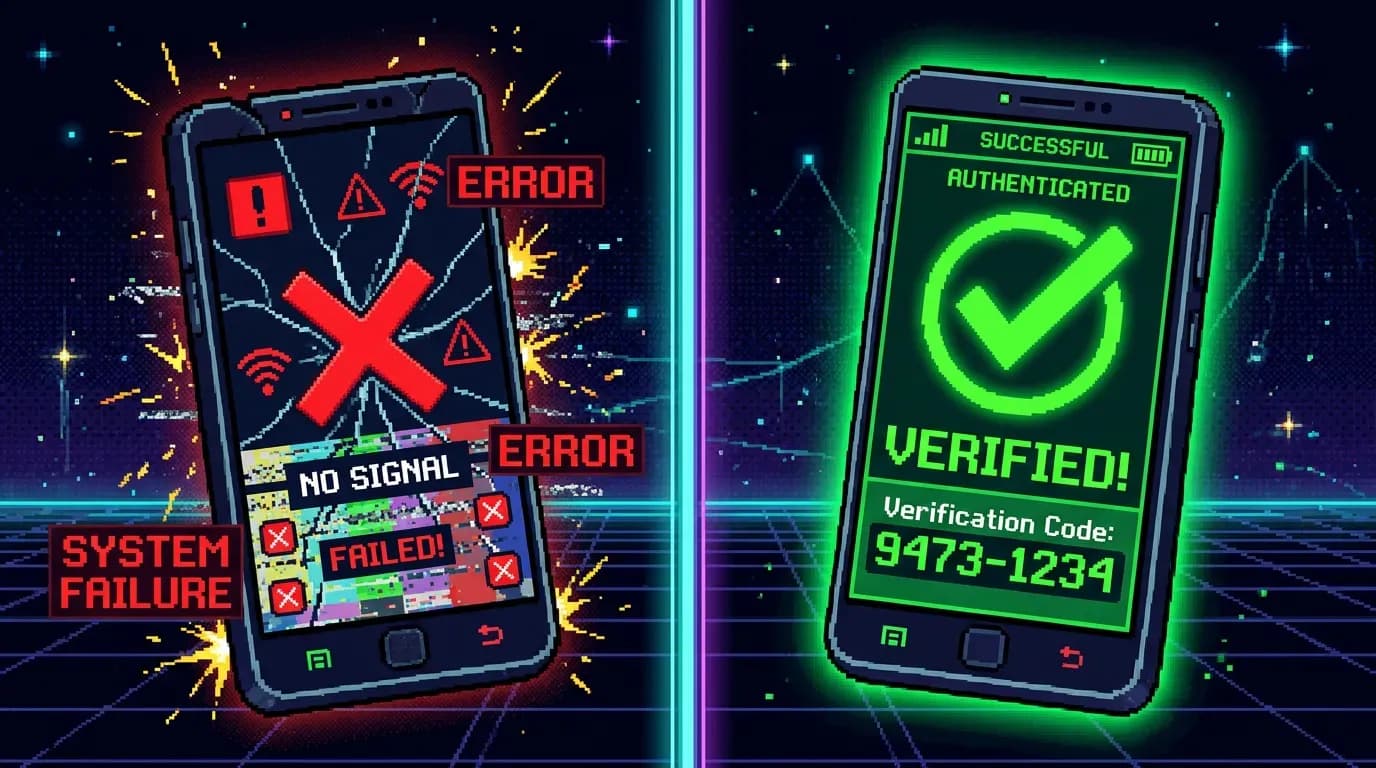
TL;DR. Free public SMS receivers almost always fail in 2026: numbers are blacklisted within hours, inboxes are public, most are VoIP. For accounts you actually want to keep, pay for a real non-VoIP carrier number. nadanada one-time numbers start at $1.50, rental numbers at $12 for 3 months. No signup.
You need to verify an account. The service wants a phone number. You don't want to use your real one. So you do what everyone does first: you Google "receive SMS online free."
You find a site. You pick a number. You enter it into the sign-up form. And then... nothing happens. The code never arrives. Or the number is already blocked by the service. Or three other people are staring at the same public inbox, racing to grab the code before you.
This is what free SMS verification looks like in 2026. It barely works, and when it does, it creates more problems than it solves.
But does that mean you need to pay? How much? And which paid services are actually worth it? What follows is an honest breakdown of every option, from free to paid, with what actually works right now.
Free SMS Verification: The Promise and the Reality
Free online SMS receivers are websites that display a list of phone numbers and show incoming messages publicly. Anyone can visit the site, pick a number, and see every SMS sent to it. No sign-up, no payment.
The most popular ones include Quackr, receive-smss.com, eSIMPlus, and MobileSMS.io's free tier. They all work the same way: a page full of numbers, a public message inbox, and the hope that your verification code shows up before someone else grabs it.
Why Free Numbers Mostly Don't Work Anymore
In the early days of these services, they worked surprisingly well. But by 2026, the landscape has changed dramatically.
Services actively block them. WhatsApp, Telegram, Signal, Google, Instagram, TikTok, X, and most major platforms maintain blacklists of phone numbers associated with mass verifications. Free SMS receivers burn through numbers at an enormous rate: thousands of verification attempts per day on each number. These numbers get flagged and blocked within hours of being published. By the time you find a free number on one of these sites, there's a good chance the service you're trying to verify with has already blocked it.
The inbox is public. This is the fundamental problem that no free service can solve. If you use a public number to verify a WhatsApp account, anyone else watching that same inbox can see your code. Worse, someone could use the code before you and hijack the account creation. For a throwaway test this might be acceptable. For any account you actually care about, it's a security risk.
Numbers disappear. Free services rotate their numbers constantly. The number you used today won't be available tomorrow. If the service you signed up for ever needs to re-verify your phone number, or if you need a password reset code sent via SMS, you're locked out.
VoIP detection. Many free numbers are VoIP-based, and in 2026 most major services check whether a number is VoIP or a real mobile number. VoIP numbers get rejected at the verification step, before any code is even sent.
When Free Numbers Still Work
To be fair, free SMS receivers aren't completely useless. They can still work for:
- Small, obscure services that don't maintain phone number blacklists
- Testing and development when you need to verify a throwaway account during QA
- One-off registrations on sites you'll never use again and don't care about securing
But for WhatsApp, Telegram, Google, social media platforms, or anything you plan to use longer than an afternoon, free numbers are a dead end.
Paid SMS Verification: What the Market Looks Like
Paid services solve the core problems of free numbers: the numbers are private (only you see the incoming messages), they're real mobile numbers (not VoIP), and they're not shared with thousands of other users so they don't get blacklisted as quickly.
But not all paid services work the same way. The main approaches compare as follows.
Account-Based Services (SMSPool, SMS-Man, TextVerified)
The biggest paid SMS verification services all follow the same model:
- Create an account (email required)
- Deposit money into a wallet balance
- Select the service you need verification for (WhatsApp, Google, etc.)
- Receive a number, get your code, done
SMSPool is one of the most popular options. Numbers start at $0.02 for basic services and go up to about $0.60 for harder-to-verify platforms like WhatsApp. They support 9+ countries and offer both one-time codes and rentals (~$13/month). Payment methods include crypto, but you first need to fund your account wallet. You also need to create an account with an email address.
SMS-Man is similar, with numbers starting at $0.05. They offer rentals up to 1 month and support a wide range of countries. Same model: account required, wallet top-up required.
TextVerified focuses on US non-VoIP numbers at $0.25 per code, with rentals starting at $1.50. They're more expensive but position themselves as higher quality.
These services work well and have high success rates. The trade-off is that your email and payment history are stored in their system. If SMSPool's database is ever breached, your email address is tied to every phone verification you've ever done through them, which might include the services you were trying to keep private in the first place.
No-Account Services (nadanada)
A different approach: no account, no email, no wallet balance. You go to the site, pick a service and country, pay directly with cryptocurrency or Apple Pay/Google Pay, and receive your code. Nothing is stored because there's nothing to store.
nadanada offers one-time verification numbers in over 100 countries, priced between $1.50 and $3.00 depending on the country. You select which service you need the code for (WhatsApp, Telegram, Google, etc.), pay, and the code arrives in your private inbox. For ongoing use, rental numbers are available at $12 for 3 months: a UK (+44) number that receives unlimited SMS and can be used for 2FA, password resets, and ongoing verification across multiple services.
The pricing is higher per verification than SMSPool's cheapest numbers. That's the honest trade-off. You're paying more for the fact that no account exists, no email is collected, and no payment trail connects you to the verification, especially if you pay with Bitcoin Lightning or Monero.
The Real Comparison: What Matters Beyond Price
Price per verification is the obvious comparison point, but it's not the only one, and for many users it's not the most important one.
Success Rate
The cheapest number is worthless if the code never arrives. Free services have abysmal success rates in 2026 because their numbers are burned. The account-based paid services (SMSPool, SMS-Man) maintain higher success rates because their numbers aren't publicly shared. nadanada uses real carrier SIM numbers, which have the highest acceptance rate across platforms.
If you've ever spent 20 minutes cycling through free numbers that all get rejected by WhatsApp, you know that "free" isn't actually free when you factor in your time.
Privacy
This is where the models diverge sharply:
Free services: Zero privacy. Public inbox. Anyone can see your codes. The site operators can see all traffic. Your IP is logged.
Account-based paid services: Your codes are private, but the service knows your email, your payment method, and exactly which platforms you've verified on. This is a centralized record of your verification activity.
No-account services (nadanada): Your codes are private. No email on file. If you pay with crypto, no payment identity on file. The service has no way to build a profile of your activity because there's no account to attach it to.
For someone who just wants a cheap verification code and doesn't care about privacy, SMSPool at $0.10 is the rational choice. For someone who wants verification without creating yet another account that stores their data, the no-account model is worth the premium.
Number Quality
Not all phone numbers are equal in the eyes of verification systems:
VoIP numbers are the cheapest to provision and the most likely to be rejected. WhatsApp, Signal, and many financial services specifically block VoIP ranges.
Virtual numbers from cloud telephony providers are a step up but still get flagged by aggressive verification systems.
Real carrier SIM numbers (actual mobile numbers on real cellular networks) have the highest acceptance rate. This is what nadanada's phone number service and the better-tier paid services provide.
The type of number matters more than the price. A $0.02 VoIP number that gets rejected is infinitely more expensive than a $2.00 real number that works on the first try.
Persistence
One-time numbers are cheaper. Rental numbers are more useful.
If you verify a Telegram account with a one-time number and then lose access to that number, you can't re-verify, you can't enable two-factor authentication, and you can't recover the account if you get logged out. For throwaway accounts this is fine. For accounts you'll actually use, a rental number that persists for months is the smarter investment.
nadanada offers both: one-time numbers from $1.50 for quick verifications, and rental numbers at $12 for 3 months for accounts you want to keep. Most competitors offer one or the other but not both from the same provider.
How to Choose: A Decision Framework
Skip the analysis paralysis. Here's when to use what:
Use a free service when: You're testing something and genuinely don't care if it works. You need to verify a throwaway account on a small platform that doesn't blacklist numbers. You have unlimited patience and time.
Use a cheap account-based service (SMSPool, SMS-Man) when: You need high-volume verifications at the lowest possible cost. You don't care that your email and payment history are stored. You're comfortable creating and managing another account.
Use a no-account service (nadanada) when: Privacy matters, and you don't want your email tied to your verification activity. You want to pay with crypto and leave no payment trail. You need real carrier numbers with high success rates. You want both one-time and rental options from the same provider.
Use a rental number when: The account matters. You'll need 2FA codes, password resets, or ongoing verification. You're registering for WhatsApp, Telegram, Signal, or any messaging app you plan to use long-term.
Payment Options
Different services accept different payment methods. Here's how they stack up:
Free services: No payment needed (you pay with your time and frustration instead).
SMSPool: Crypto (BTC, ETH, LTC, USDT), PayPal, credit card, Google Pay, Apple Pay. Requires account wallet top-up, and minimum deposits apply.
SMS-Man: Credit card, crypto, various payment processors. Also requires account wallet top-up.
TextVerified: Credit card, PayPal, crypto. Account and balance required.
nadanada: Bitcoin Lightning (5% discount), Bitcoin on-chain, Monero, Ethereum, Solana, USDT, USDC, Apple Pay, Google Pay. Direct payment per purchase: no account, no wallet, no minimum deposit. Pay exactly what you need, when you need it.
For privacy-focused users, the payment method matters as much as the service itself. Paying with a credit card links your real identity to the purchase. Paying with Bitcoin Lightning or Monero doesn't.
The Bottom Line
Free SMS verification services were a viable option a few years ago. In 2026, they're mostly broken: numbers are burned, codes don't arrive, and the security risks of public inboxes make them unsuitable for anything you care about.
Paid services work. The question is what you're optimizing for. If it's raw cost per verification and you don't mind creating accounts, the established players like SMSPool deliver at cents per code. If it's privacy (no account, no email, no payment trail, real carrier numbers), nadanada fills a gap that the account-based services can't, at a price point that's still a few dollars per verification or $4 per month for a rental number you can use across everything.
The worst option in 2026 is using your real phone number. With SIM swap attacks surging, data breaches exposing phone numbers in every other headline, and cross-platform tracking built on phone number correlation, the few dollars for a separate verification number is the cheapest security upgrade you can make. Pair it with an anonymous eSIM and a no-log VPN and you've built a solid privacy stack without handing over any personal data.
Frequently Asked Questions
Why do free SMS verification numbers get blocked so quickly? Because thousands of people use each number every day. Services like WhatsApp and Google track how many verification attempts come from each number. When a number exceeds a threshold, it gets blacklisted. Free public numbers hit these thresholds within hours.
Are paid verification numbers guaranteed to work? No service can guarantee 100% success because the platforms being verified against constantly update their detection systems. But real carrier SIM numbers from paid services have significantly higher success rates than free or VoIP numbers. Most paid services offer refunds or retries if a code doesn't arrive.
Is it legal to use a different phone number for verification? Using a phone number you've legitimately purchased or rented for account verification is legal. You're providing a valid phone number, it just isn't your personal carrier number. Whether a specific platform's terms of service allow third-party numbers varies by platform.
Can I port a rental number to my personal phone? No. Rental numbers are virtual, existing on the provider's infrastructure. You access messages through a web interface or API, not through your phone's native SMS app.
What's the difference between VoIP and non-VoIP numbers? VoIP numbers are provisioned through internet telephony providers and are cheaper to create. Non-VoIP numbers are real mobile numbers on cellular carrier networks. Many verification systems block VoIP numbers because they're associated with spam and fraud. Non-VoIP numbers pass these checks because they're indistinguishable from a regular phone.
How do I know if a number will work for the service I need? On services like nadanada and SMSPool, you select which platform you need verification for before purchasing. The system provides a number that's compatible with that platform. This service-specific matching dramatically improves success rates compared to grabbing a random number and hoping for the best. Check the nadanada FAQ for a full list of supported platforms and countries.
Related guides: SMS Verification Without Your Real Phone Number · How to Rent a Phone Number Long-Term
nadanada provides anonymous one-time and rental phone numbers in 100+ countries, eSIM data plans, and WireGuard VPN, payable with Bitcoin Lightning, Monero, Ethereum, Solana, USDT, USDC, and more. No accounts. No KYC. Get a phone number now.