Russia's Internet Censorship in 2026: What's Blocked, What Still Works, and the Honest Truth About eSIMs and VPNs
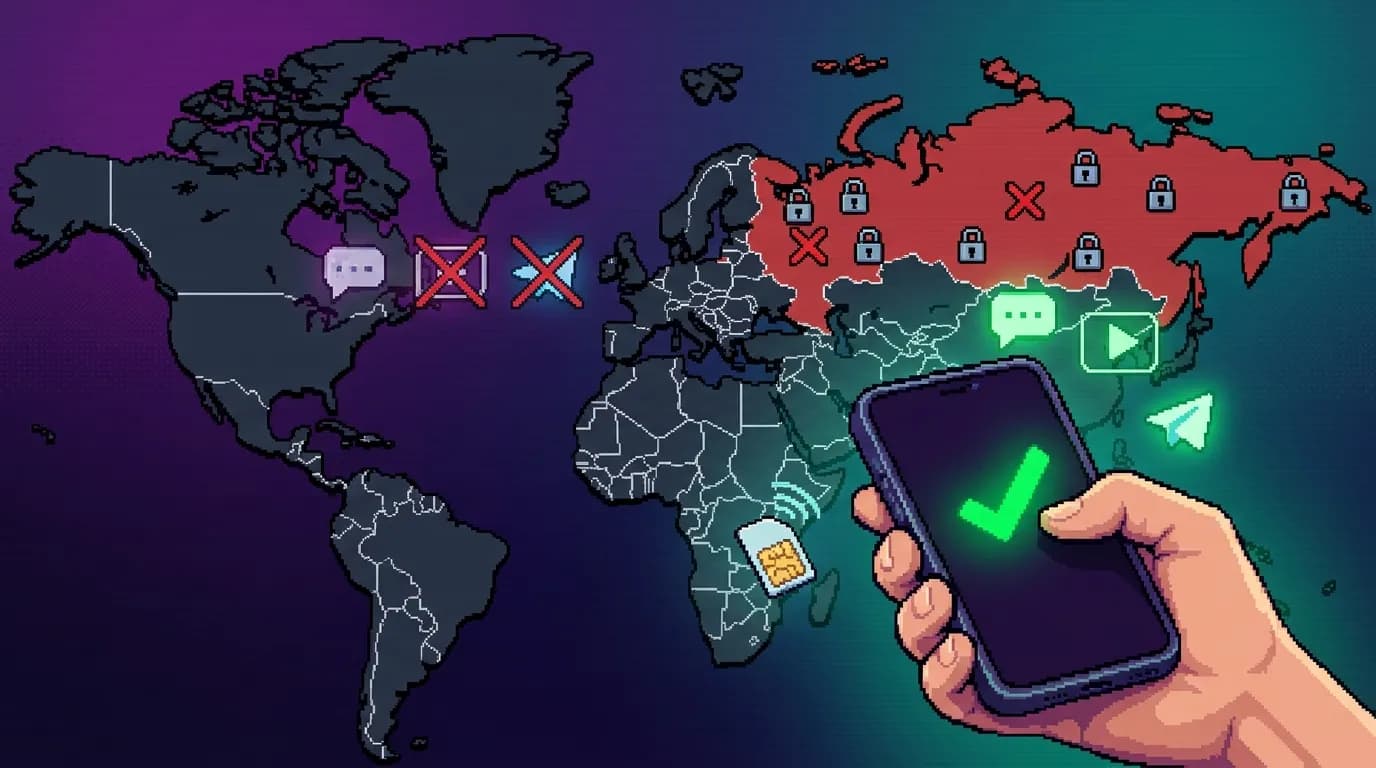
TL;DR. Russia has blocked WhatsApp, YouTube, Telegram, Signal, Discord, and most VPN protocols via TSPU deep packet inspection. The most reliable workaround left is a foreign eSIM in roaming, which routes traffic home through GRX/IPX rather than Russian filters. After a 24-hour data block on arrival, access resumes normally.
On February 12, 2026, Russia officially blocked WhatsApp. The Kremlin's spokesperson Dmitry Peskov attributed the ban to WhatsApp's "reluctance to comply with the norms and letter of Russian law" and directed citizens toward MAX, a state-backed messaging platform that openly declares it will share user data with authorities on request and does not use end-to-end encryption.
WhatsApp was the last widely used encrypted Western messaging platform still operating in Russia. Its removal marks the most significant step yet in what observers have called Russia's "Digital Iron Curtain," a systematic effort to cut Russian internet users off from unmonitored global communication tools.
This post is a factual overview of what is currently blocked in Russia, how the remaining workarounds actually function at a technical level, and, critically, where those workarounds are starting to fail. Most guides on this topic oversimplify, and some are actively misleading. The situation on the ground is changing fast, and honesty matters more than optimism.
What Is Currently Blocked in Russia (April 2026)
The list has grown substantially over the past two years.
WhatsApp. Fully blocked since February 12, 2026. Domains removed from Russia's National Domain Name System, preventing devices from resolving the IP addresses needed to connect. Had been partially accessible via VPN since December 2025, but the DNS-level block made even that unreliable.
YouTube. Heavily throttled throughout 2025, then effectively blocked in early 2026. Video loading speeds were reduced to unusable levels before full blocking was implemented.
Instagram and Facebook. Both blocked since March 2022, following the start of the full-scale invasion of Ukraine. Meta Platforms was designated an "extremist organization" by a Russian court.
Signal. Blocked since August 2024.
Discord. Blocked since October 2024.
FaceTime. Targeted since December 2025.
Telegram. The most dramatic recent case. Russia began throttling Telegram in February 2026, blocking voice and video calls, then limiting download speeds to make media content unusable. Users reported major outages across multiple regions starting March 14-15, two weeks ahead of the planned April 1 full block. By late March, Telegram became largely inaccessible across Russia, with both mobile and desktop versions affected. The FSB opened an investigation against Pavel Durov's company on allegations of aiding terrorism. Russia's VPN crackdown in April 2026, intended to prevent circumvention, actually triggered failures in Russia's own domestic payment systems, disrupting services like the Moscow metro.
VPN services. Russia has been blocking VPN protocols systematically since 2023. The TSPU (Technical System of Countermeasures to Threats), a deep packet inspection system installed at major internet exchange points, detects and blocks common VPN protocols including OpenVPN, WireGuard, and IPSec. Some VPN providers still work using obfuscated protocols, but the cat-and-mouse game is constant and reliability changes week to week.
The state alternative: MAX. The Kremlin is actively pushing MAX as the replacement for all blocked services. MAX does not offer end-to-end encryption and explicitly cooperates with Russian security services. Advertising on any blocked platform (Telegram, WhatsApp, Instagram, YouTube) is now prohibited, with fines up to 500,000 rubles.
How eSIM Roaming Works (The Technical Reality)
One approach that has received significant attention is using a foreign eSIM to route internet traffic outside of Russia's filtering infrastructure. Before discussing whether this still works, it helps to understand what is actually happening at the network level.
When a phone with a foreign SIM or eSIM connects to a cell tower in Russia, the local carrier (MTS, Beeline, Megafon, etc.) recognizes it as a foreign roaming subscriber. Under standard international roaming protocols established by the GSMA, the local carrier is obligated to tunnel that subscriber's data back to the home carrier's network through a system called the GPRS Roaming Exchange (GRX), using GTP (GPRS Tunnelling Protocol).
In "home-routed" roaming, which is the default configuration for most European carriers, this means your data travels through the following path:
- Your phone connects to a local Russian cell tower for the radio signal.
- The tower identifies your SIM as a foreign roamer.
- Your data is tunneled through the GRX back to a gateway in the home carrier's country (for example, the UK).
- Your data exits to the public internet from the UK gateway, with a UK IP address.
Because your traffic never exits to the public internet inside Russia, Russia's TSPU filtering system does not see it as local traffic to be filtered. The IP address visible to websites and apps is from the home carrier's country, not from Russia. This is the same system that has handled international roaming since the late 1990s, used by every tourist, diplomat, and business traveler worldwide.
This is fundamentally different from a VPN. A VPN encrypts traffic at the application layer, but the encrypted packets still travel through the local ISP before reaching the VPN server. Russia's DPI systems can detect VPN protocol signatures and block them. An eSIM routes traffic at the network infrastructure level, below the layer where Russia's filtering operates.
The Part Most Guides Leave Out: Russia Is Fighting Back
This is where the honest version of this story diverges from the simplified one.
The 24-hour block. Since October 6, 2025, Russia has imposed a mandatory data and SMS block on all foreign SIMs and eSIMs for the first 24 hours after they connect to a Russian mobile network. Voice calls still work during this period, but mobile data and SMS are completely dead. This was introduced as a "temporary security measure" with no announced end date. It affects every foreign eSIM and SIM card without exception.
eSIM providers pulling out. Following the 24-hour block and the broader regulatory crackdown, multiple major international eSIM providers stopped selling Russia plans entirely in late 2025 and early 2026, including Holafly and eSIM.sm. The providers that still offer Russia coverage have had to implement workarounds (such as activation via SMS through specific Russian carriers) that add complexity and reduce reliability.
Intermittent disruptions. Russians who purchased foreign eSIMs specifically to bypass internet blocks have reported increasing service interruptions throughout early 2026. There are indications that Russian authorities are exploring ways to interfere with or restrict foreign roaming traffic more aggressively, though the technical and diplomatic constraints of breaking international roaming agreements make a complete shutdown difficult.
The legal gray area is getting grayer. Russia's VPN bans specifically target "VPN software and services" and "anonymizers," not international roaming. Using a foreign SIM while physically in Russia is a standard, legal telecommunications activity protected by international treaties (ITU conventions, GSMA bilateral roaming agreements). However, Russia has shown a willingness to stretch its own laws and test the boundaries of international norms. The fact that something is technically legal today does not guarantee it will remain legal or functional tomorrow. Russia has already demonstrated a willingness to impose temporary blocks on foreign SIM connectivity when it suits their security objectives.
SIM registration requirements. Since January 1, 2025, all Russian mobile operators are required to link every SIM card to a Gosuslugi (state services) account. Millions of unregistered SIMs were deactivated overnight. Buying a physical SIM in Russia as a tourist has become practically impossible without a Russian contact who can register it on their Gosuslugi account.
What About VPNs?
VPNs remain the other major tool for accessing blocked services in Russia, but the situation has deteriorated significantly.
Russia's TSPU system uses deep packet inspection at major internet exchange points to detect and block VPN protocols. Standard WireGuard, OpenVPN, and IPSec connections are routinely blocked. Some providers have responded with obfuscated protocols that disguise VPN traffic as regular HTTPS, but Russia's DPI capabilities are constantly improving, and any given obfuscation method may work one week and fail the next.
The providers that still function in Russia tend to be those investing heavily in protocol obfuscation and infrastructure diversity: frequently rotating server IPs, using domain fronting, deploying custom transport layers. Even then, reliability is inconsistent.
The practical difference between VPNs and eSIM roaming in Russia is this: VPN traffic passes through Russian ISP infrastructure and must disguise itself to avoid detection. eSIM roaming traffic is tunneled at the network layer and exits Russia through the carrier's international interconnect, which historically has not been subject to the same filtering. However, the 24-hour block demonstrates that Russia is willing to interfere with roaming traffic when motivated, even if it cannot (yet) fully inspect or filter it.
The Honest Assessment: What Works in April 2026
Foreign eSIM roaming still works for accessing blocked services after the initial 24-hour block, for users who can obtain a plan from a provider still serving Russia. The technical architecture of home-routed roaming remains intact, and the data still exits Russia through the home carrier's gateway. But the 24-hour block is real, the number of providers offering Russia coverage is shrinking, and there is no guarantee that Russia will not impose further restrictions. Anyone relying on this approach should have a backup plan.
VPNs with obfuscated protocols work intermittently. Reliability varies by provider, by protocol, by server, and by week. The best approach is to have multiple VPN providers configured and ready, because any single one can stop working without warning.
Neither approach is guaranteed. This is the part that matters most, and the part most commercial guides gloss over because admitting uncertainty doesn't sell products. The Russian government is actively, continuously working to close every loophole. What works today may not work next week. The trajectory is toward more restriction, not less.
The strongest practical setup for someone who needs reliable access to blocked services in Russia in April 2026 is a combination: a foreign eSIM for the baseline connection (after surviving the 24-hour block), plus one or more VPN services with obfuscated protocols as a fallback if eSIM roaming is disrupted. Neither alone is a complete solution anymore. If your phone doesn't support eSIM natively, an eSIM-to-SIM adapter in a portable router is another option worth considering.
The Broader Context: Not Just Russia
Russia is the most aggressive current example, but the pattern of governments restricting internet access through technical means is global and accelerating.
China's Great Firewall has blocked Google, YouTube, Facebook, Instagram, WhatsApp, and many other Western services for years. Foreign eSIMs with home-routed roaming generally still work in China to access these services, and China has been less aggressive than Russia about interfering with roaming traffic, likely because of the volume of business and tourist travel. But the Great Firewall's DPI capabilities are sophisticated, and VPN crackdowns in China intensify periodically. For travelers headed to China or other restrictive countries, combining a no-KYC eSIM with a VPN provides the most resilient setup.
The UAE restricts VoIP calling services (WhatsApp calls, FaceTime, Skype) to protect the revenue of local telecoms operators Etisalat and du. Foreign eSIMs routed through non-UAE carriers bypass these VoIP restrictions because the traffic exits through the home carrier's gateway, not through UAE infrastructure. Digital nomads who frequently move between restrictive jurisdictions often keep a foreign eSIM active for exactly this reason.
Iran, Turkey, Myanmar, and others have all implemented various forms of internet restriction. The technical approaches differ, but the principle is the same: domestic ISP-level filtering can be circumvented by traffic that exits the country at the network layer before reaching the public internet.
In every case, the same honest caveat applies: these workarounds exist in the gap between what governments want to control and what they can technically accomplish within the constraints of international telecom infrastructure. That gap can narrow at any time.
What to Consider Before Relying on Any Workaround
If you are a traveler visiting Russia, a resident trying to maintain communication with the outside world, a journalist, or anyone else who needs access to blocked services, here is what matters:
Have multiple options ready. Do not depend on a single tool. Set up a foreign eSIM, configure one or two VPN services with obfuscated protocols, and download any apps or content you might need before entering the country. Once services are blocked, downloading new tools becomes significantly harder.
Understand the 24-hour block. If you are arriving in Russia with a foreign eSIM, expect no data for the first 24 hours after your phone connects to a Russian tower. Plan accordingly: download maps, messages, and anything else you need while still on WiFi or before crossing the border.
Keep software updated. VPN providers and eSIM providers that still serve Russia are frequently updating their infrastructure to counter new blocking methods. Use the latest versions of everything.
Do not assume permanence. Whatever works today may not work next month. The Russian government's trajectory is clearly toward more restriction. Build habits and infrastructure that let you adapt, not just connect.
Consider the legal environment. Using a foreign eSIM for roaming remains standard, legal telecommunications activity under international law. Using a VPN is more ambiguous: Russia's laws target "anonymizers" and VPN services, and while enforcement against individual users has been minimal, the legal framework exists. This post is a technical explainer, not legal advice. Anyone operating in a high-risk environment should assess their own situation with appropriate care.
Timeline: Russia's Path to the Digital Iron Curtain
For context, here is the condensed timeline of how Russia arrived at the current state of internet restriction:
March 2022. Instagram and Facebook blocked after Russia's full-scale invasion of Ukraine. Meta designated an "extremist organization."
2023-2024. Systematic VPN blocking begins via the TSPU system. Signal blocked (August 2024). Discord blocked (October 2024).
January 2025. All Russian SIM cards must be linked to a Gosuslugi account. Millions of unregistered SIMs deactivated.
October 2025. 24-hour data block imposed on all foreign SIMs and eSIMs connecting to Russian networks.
December 2025. FaceTime targeted. WhatsApp becomes accessible only through VPN in many regions.
February 2026. WhatsApp officially banned. Domains removed from National DNS. YouTube fully blocked. Telegram "phased restrictions" begin. State messenger MAX promoted as the only sanctioned alternative.
March 2026. Advertising on all blocked platforms prohibited (fines up to 500,000 rubles). Telegram restrictions escalate.
March-April 2026. Telegram fully blocked ahead of the announced April 1 date, with nationwide outages from mid-March. VPN crackdown causes collateral damage to Russia's own domestic payment systems. Foreign eSIM users report increasing disruptions.
FAQ
Is using a foreign eSIM in Russia illegal? No. International roaming is a standard telecommunications service governed by ITU treaties and GSMA bilateral agreements. Russia's VPN bans target software-based anonymizers, not the international roaming infrastructure. However, Russia has shown willingness to disrupt foreign SIM service (the 24-hour block), and the legal environment is unpredictable.
Is using a VPN in Russia illegal? Russia has laws against "anonymizers" and has blocked numerous VPN services. Enforcement against individual users has been limited so far, but the legal framework exists. This is a risk assessment only you can make for your own situation.
Why can't Russia just block all foreign eSIM traffic? Because international roaming is governed by bilateral agreements between carriers and international treaties. Completely blocking foreign roaming would affect every tourist, business traveler, and diplomat in the country, and would effectively isolate Russia from the global telecommunications system. Russia has shown it is willing to disrupt roaming temporarily (24-hour block) but has not yet moved to block it entirely. Whether this changes is an open question.
Does the eSIM roaming approach work in China too? Generally yes. Foreign eSIMs with home-routed data still bypass the Great Firewall in most cases. China has been less aggressive about interfering with roaming traffic than Russia, but the technical capability exists.
What is MAX, the Russian state messenger? MAX is a state-backed messaging and services platform that Russia is promoting as the replacement for WhatsApp, Telegram, and other blocked apps. It does not use end-to-end encryption and explicitly states it will share user data with Russian authorities on request.
Can I still buy a local SIM card as a tourist in Russia? Extremely difficult since January 2025. All SIMs must be registered to a Gosuslugi account, which requires Russian documentation or a Russian contact willing to register on your behalf. This is part of a broader global trend of SIM registration and identity requirements that privacy-conscious users are increasingly trying to avoid.
What is the TSPU? The Technical System of Countermeasures to Threats (TSPU) is Russia's deep packet inspection infrastructure, installed at major internet exchange points. It inspects traffic passing through Russian ISPs and can detect and block VPN protocols, specific domains, and other traffic patterns. It is the primary technical tool Russia uses to enforce its internet blocks.
How much data do I need if I use a foreign eSIM in Russia? For messaging and light browsing, 1 to 3 GB per week. For video calls and streaming, 5 to 10 GB per week. Keep in mind that video-heavy services consume data quickly when unthrottled.
Related guide: China Internet Guide 2026: eSIM, VPN and the Great Firewall. The same roaming technique works in other restrictive countries.
nadanada provides anonymous eSIM data plans in 200+ countries, pay-per-use WireGuard VPN, disposable and rental phone numbers, and free anonymous AI chat. All services payable with Bitcoin Lightning, Monero, Ethereum, Solana, USDT, USDC, and more. No accounts, no KYC. Visit nadanada.me.